When loading the food, leave enough space inside the refrigerator to allow sufficient air circulation for cooling.
Since hot and humid air will not directly penetrate into your product when the doors are not opened, your product will optimize itself in conditions sufficient to protect your food. Under these circumstances, functions and components such as compressor, fan, heater, defrost, lighting, display and so on will operate according to the needs by consuming minimum energy.
In case that multiple options are present, glass shelves must be placed so that the air outlets at the rear wall are not blocked and preferably, in a way that air outlets remain below the glass shelf. This combination may help improving air distribution and energy efficiency.
Using the below drawer when storing is strongly recommended.
For optimum performance, Quick Freezing can be used (if available), 24 hours prior to placing fresh foods in the freezer.
In most cases, 24 hours is enough for the Quick Freezing function after fresh foods are placed in the freezer. After some time, Quick Freezing function will deactivate automatically.
When freezing a small amount of food, Quick Freezing function can be deactivated after some time to ensure energy saving.
Depending on the product’s features; defrosting frozen foods in the refrigerator compartment will ensure energy saving and preserve food quality.
In order to load the maximum quantity of food into the freezer compartment of your appliance, the upper drawers should be taken out and the food should be placed onto the wire/glass shelves.
Store food in refrigerator according to proper storage conditions to save energy.
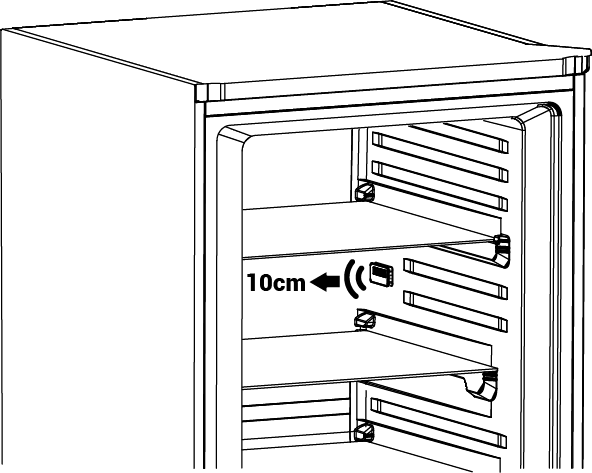
Food packages shall not be in direct contact with the temperature sensor located in the freezer compartment.
There should be 10 cm of distance between the sensor and the food.