Troubleshooting
Read the "Safety Instructions" first!
If you are unable to resolve the problem even after following the instructions in this section, contact the retailer or authorized service center where you purchased the product. Never attempt to repair the malfunctioning product yourself.
The refrigerator does not work.
- The plug is not fully seated in the socket. >>> Insert the plug so that it is fully seated in the socket.
- The fuse in the outlet the product is plugged into, or the main fuse, has blown. >>> Check the fuse.
Condensation on the side wall of the refrigerator compartment.
- The door has been opened and closed too frequently. >>> Please be careful not to open and close the product's door too often.
- The environment is very humid. >>> Do not install the product in very humid environments.
- Foods containing liquids may be stored in open containers. >>> Store foods containing liquids in closed containers.
- The product door was left open. >>> Do not leave the product door open for a long time.
- The thermostat is set to too cold. >>> Adjust the thermostat to the appropriate setting.
The compressor is not working.
- In the event of a sudden power outage or when the plug is removed and reinserted, the compressor's protective thermal switch will trip because the gas pressure in the product's cooling system has not yet equalized. The product should start working again after approximately 6 minutes. If the product does not start working after this time, call for service.
- It is in the defrost cycle. >>> This is normal for a fully automatic defrosting product. The defrost cycle occurs periodically.
- The product is not plugged into the power outlet. >>> Please make sure the plug is plugged into the power outlet.
- The temperature settings are incorrect. >>> Select the appropriate temperature setting.
- The power has been cut off. >>> The product will continue to function normally once the power is restored.
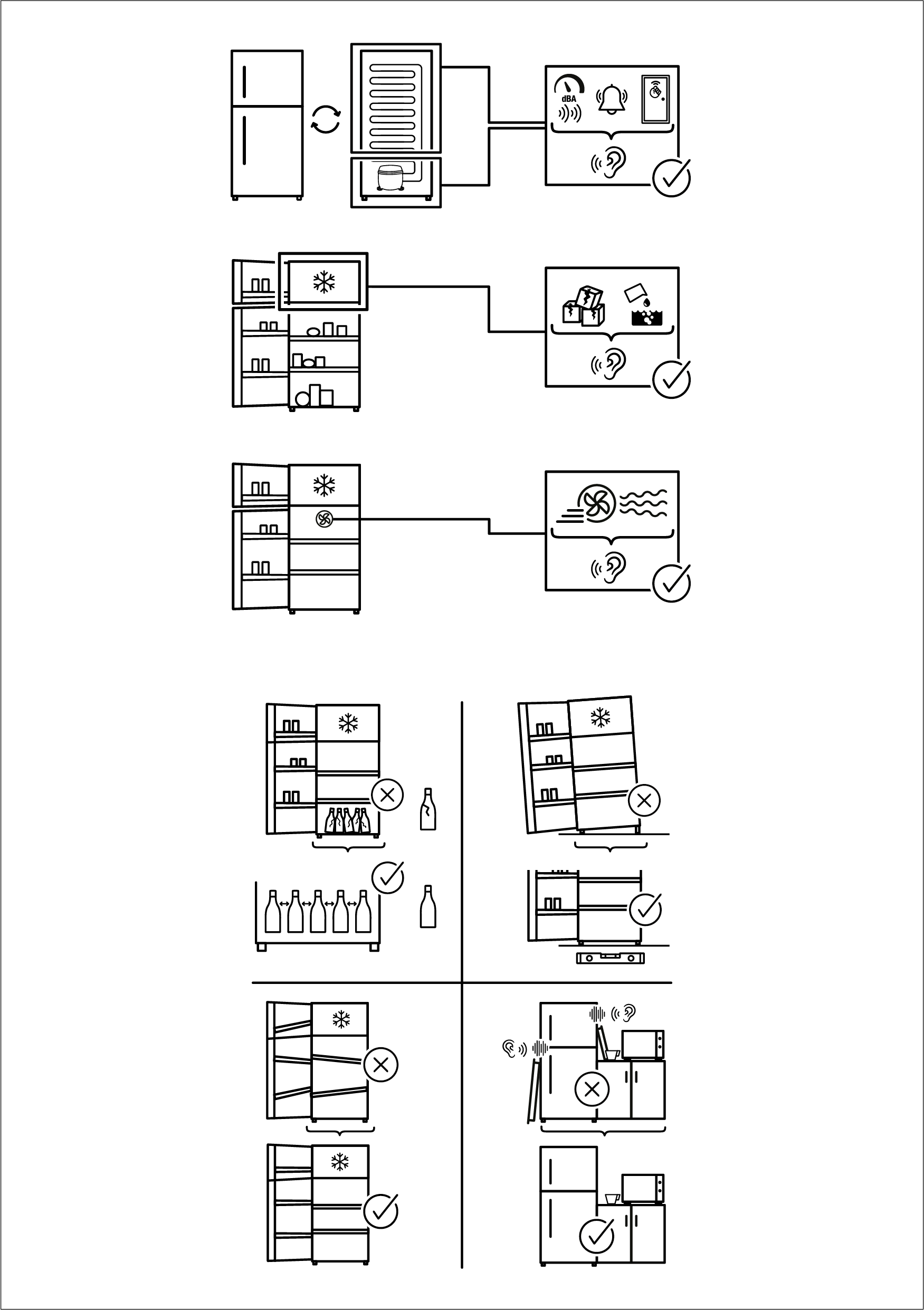
The refrigerator's operating noise increases when it's running.
- The product's performance may vary depending on changes in ambient temperature. This is normal and not a malfunction.
The refrigerator is running too often or for too long.
- The new product may be larger than the old one. Larger products last longer.
- The room temperature may be high. >>> It is normal for it to operate for longer periods in hot environments.
- The product may have been recently plugged in or new food may have been added. >>> When the product is newly plugged in or new food is added, it takes longer to reach the set temperature. This is normal.
- The product may have recently been served with large quantities of hot food. >>> Do not serve hot food in this product.
- The doors have been opened frequently or left open for extended periods. >>> The warm air entering causes the product to operate longer. Do not open the doors too often.
- The refrigerator door may have been left ajar. >>> Check if the doors are completely closed.
- The product is set to a very low temperature. >>> Adjust the product's temperature to a higher setting and wait for it to reach that temperature.
- The refrigerator door seal may be dirty, worn, broken, or not properly seated. >>> Clean or replace the seal. A damaged/broken door seal will cause the appliance to run longer to maintain its current temperature.
The freezer temperature is too low, but the refrigerator temperature is adequate.
- The freezer compartment temperature is set to a very low value. >>> Adjust the freezer compartment temperature to a higher setting and check.
The refrigerator temperature is too low, but the freezer temperature is adequate.
- The refrigerator compartment temperature is set to a very low value. >>> Adjust the refrigerator compartment temperature to a higher setting and check.
Food stored in refrigerator drawers freezes.
- The refrigerator compartment temperature is set to a very low value. >>> Adjust the refrigerator compartment temperature to a higher value and check.
The temperature in the refrigerator or freezer is too high.
- The refrigerator compartment temperature may be set too high. The refrigerator compartment temperature setting affects the freezer compartment temperature. Try adjusting the refrigerator or freezer compartment temperature and wait until the temperature in either compartment reaches a satisfactory level.
- The doors have been opened frequently or left open for too long. >>> Don't open the doors too often.
- The door might be ajar. >>> Close the door completely.
- The product may have been recently plugged in or new food may have been added. >>> This is normal. When the product is newly plugged in or new food is added, it takes longer than usual to reach the set temperature.
- The product may have recently been served with large quantities of hot food. >>> Do not serve hot food in this product.
Shaking or noise.
- The floor is not level or stable. >>> If the product wobbles when moved slowly, adjust its feet to balance it. Also, make sure the floor is stable enough to support the product's weight.
- Items placed on the product may be causing noise. >>> Remove any items from the product.
- The product is making sounds such as liquid leaking or spraying.
- Due to the product's operating principles, liquid and gas flows occur. >>>This is normal and not a malfunction.
The product is making a wind noise.
- A fan is used to perform the cooling process of the product. This is normal and not a malfunction.
Condensation is forming on the inner walls of the product.
- Hot and humid weather increases icing and condensation. This is normal and not a malfunction.
- The doors have been opened frequently or left open for too long. >>> Don't open the doors too often, and close them if they are open.
- The door might be ajar. >>> Close the door completely.
Condensation is forming on the outside of the product or between the doors.
- The air may be humid, which is quite normal in humid weather. Condensation disappears when the humidity decreases.
The inside of the product smells bad.
- Regular cleaning has not been performed. >>> Regularly clean the inside of the product with a sponge, warm water, or baking soda solution.
- Some containers or packaging materials may have odors. >>> Use odor-free containers or packaging materials.
- The food items were placed in open containers. >>> Store food in closed containers. Microorganisms released from food stored in open containers can cause unpleasant odors.
- Remove any expired or spoiled food from the product.
The door won't close.
- Food packages might be preventing the door from closing. >>> Move any packages that are blocking the doors.
- The product may not stand completely upright on the ground. >>> Adjust the legs to balance the product.
- The floor is not level or stable. >>> Ensure the floor is level and stable enough to support the product.
The vegetable drawers are cramped.
- Food items may be touching the top of the drawer. >>> Organize the food in the drawer.
There is heat on the product surface.
- While your product is operating, you may experience high temperatures between the two doors, on the side panels, and in the rear grille area. This is normal and does not require any servicing.
The fan continues to run when the door is opened.
- The fan may continue to operate even when the freezer door is opened.
If you are unable to resolve the problem even after following the instructions in this section, contact the retailer or authorized service center where you purchased the product. Do not attempt to repair the malfunctioning product yourself. This is normal.